Lucky.fun provably fair
Lucky.fun Provably Fair Originals & Round Verification
Updated November 2026
Licensed
 Available in US
Fast payouts
18+ Only
Lucky.fun has a Provably Fair section, and Lucky Originals include Plinko, Dice, Mines, Keno and Limbo. The useful question is not whether the label makes a game easier to beat; it is whether the cryptographic record lets you check that a round followed the committed result path.
Every bet placed on Lucky Originals also counts toward XP progression in the Lucky.fun VIP program and Lucky Coin rakeback system.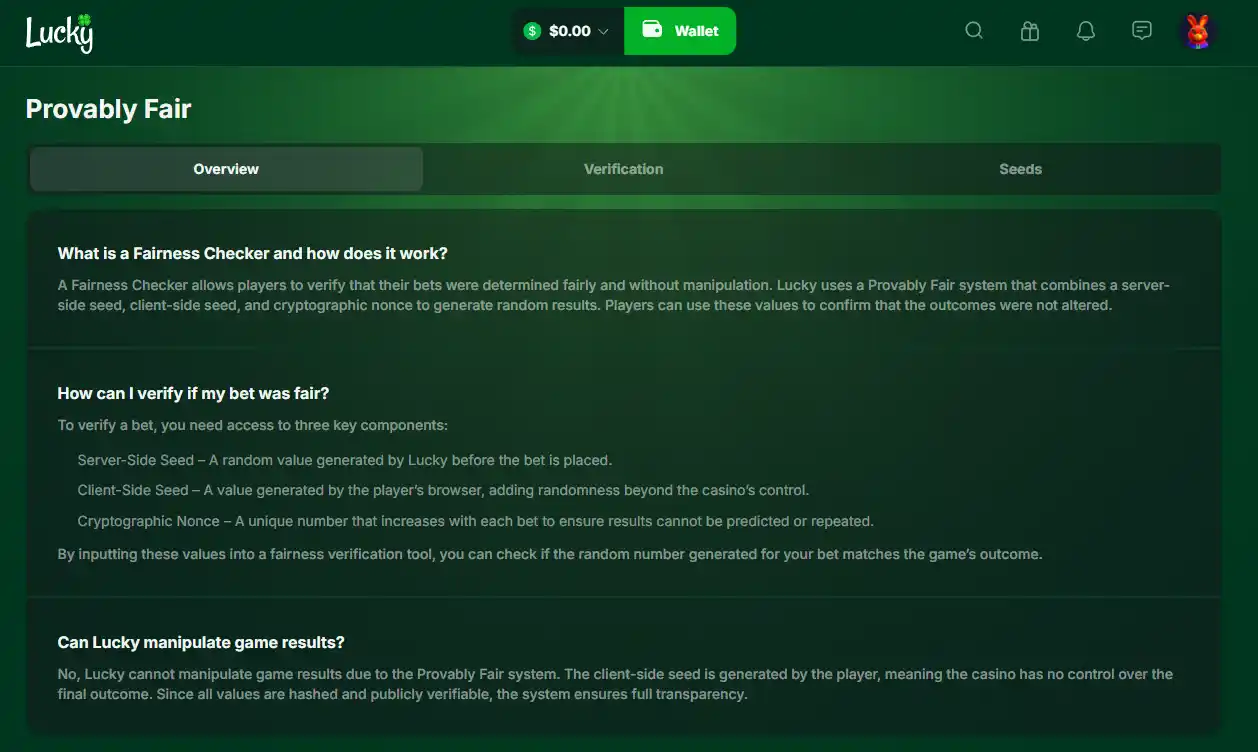
- Lucky OriginalsPlinko, Dice, Mines, Keno, Limbo
- Fairness accessProvably Fair section
- Game library contextAbout 50–55+ providers alongside originals
- Best use of verificationCheck round integrity after play
Lucky Originals Provably Fair Games and Round Verification
Lucky.fun combines a large third-party catalogue with an in-house range called Lucky Originals. The originals include Plinko, Dice, Mines, Keno and Limbo, and the site also carries a Provably Fair section. That gives the in-house games a different kind of transparency question from a conventional provider slot or live-dealer table. With a third-party title, you normally read the game rules, paytable and provider information. With a provably-fair original, there is an additional layer: cryptographic data can be used to test whether the revealed result is consistent with a commitment made around the round. The two approaches are not interchangeable, and neither one tells you that a game is likely to make money.| Game context | Lucky.fun examples | What to inspect |
|---|---|---|
| Lucky Originals | Plinko, Dice, Mines, Keno, Limbo | Round data, cryptographic commitment and any verifier supplied with the game |
| Third-party studio games | Titles from providers such as Pragmatic Play, Play'n GO, NetEnt and Evoplay | Game rules, paytable, provider information and title-specific settings |
| Live dealer | Evolution and Ezugi tables | Table rules, betting limits and the live game procedure |
A cryptographic commitment lets the game prove it did not rewrite the result afterward
The core idea is easier to understand if you separate commitment from revelation. Before the player sees the final result, a provably-fair design can commit to hidden data by publishing a cryptographic hash. A hash acts like a compact fingerprint: changing the underlying input produces a different output, while the original hidden input cannot practically be reconstructed from the fingerprint alone. After the round, the hidden value can be revealed. You hash it again and compare the new fingerprint with the earlier commitment. If they match, the revealed value is consistent with the value that was committed before the result was settled. A game can also combine several inputs—often server-side data, player-side data and a round counter—before deriving the result. Exact field names vary between implementations, so the verifier itself should show what it expects.CommitmentA hash published before the underlying secret is revealed.
SeedAn input used by the game algorithm. A typical design can combine more than one seed.
Nonce or round counterA changing value that helps make successive rounds derive different outputs from related inputs.
RevealThe stage where enough data becomes visible for the earlier commitment to be checked.
VerificationRecomputing the relevant hash or result and comparing it with the recorded round data.
Think of it like sealing a prediction in a tamper-evident envelope. The seal does not tell you whether the prediction is favorable. It tells you whether the contents revealed later match what was sealed earlier.
A useful check follows the round from commitment to recomputed result
Lucky.fun provides a Provably Fair section, but the exact controls can differ from game to game. When a Lucky Original exposes round data and a verifier, use the information shown for that specific round rather than assuming every original uses identical labels.- Identify the round. Start with the game and round record you want to inspect so you do not mix data from different wagers.
- Find the committed value. Look for the pre-round hash or equivalent commitment shown by the fairness interface.
- Collect the revealed inputs. After the round, note the seed values, counter or other fields that the verifier asks for.
- Run the verifier. Recompute the hash or game output using the supplied verification path rather than manually guessing how the algorithm works.
- Compare the result. A match means the revealed inputs are consistent with the earlier commitment and the verifier's stated algorithm.
If the hash matches
The revealed input corresponds to the earlier commitment. That is the basic evidence you want from the cryptographic check.If the result recomputes
The verifier can reproduce the round outcome from the supplied inputs according to its stated transformation.If something does not match
Recheck the round identifier, copied values and field order first. A mismatch is a reason to stop and inspect the record rather than continue on assumption.A successful fairness check proves less—and more—than many players assume
What the check can establish
- The revealed data matches the earlier cryptographic commitment.
- The verifier can reproduce the round result from the inputs it uses.
- The committed result path was not simply swapped after the wager.
What the check does not establish
- That the next round is predictable.
- That a game has a favorable expected return.
- That short-term variance will be low.
- That a winning or losing streak is unusual by itself.
Fairness verification sits beside house edge, volatility and bankroll risk
Three different questions are easy to blur together. First: was the round produced consistently with the committed data? That is where provably fair helps. Second: what mathematical advantage does the game retain over time? That belongs to the game rules and any title-specific return information. Third: how wide can short-term results swing? That is a volatility question.| Question | Provably fair answers it? | Where to look instead |
|---|---|---|
| Was this round consistent with the cryptographic commitment? | Yes, when the verifier reproduces the recorded result. | Round data and the fairness verifier. |
| Will the next round win? | No. | It cannot be known from the previous proof. |
| What is the game's long-run mathematical return? | No. | Game-specific rules or return information. |
| How severe can short-term swings be? | No. | Game mechanics, stake size and session length. |
Look for reproducibility before treating a “provably fair” label as useful
The strongest version of provably fair is not the badge itself; it is the ability to reproduce what happened. A practical verification path should give you enough information to connect the commitment, the revealed inputs and the resulting round without asking you to trust an unexplained green check mark.- Start from the specific round you played rather than a generic fairness description.
- Identify the pre-round commitment or hash before inspecting the revealed secret.
- Use the verifier's own field order and algorithm description.
- Confirm that the recomputed value matches the round record.
- Keep fairness verification separate from stake sizing, bonus rules and expected return.
Questions about Lucky.fun provably fair games
Which Lucky.fun games are associated with provably fair play?
Lucky Originals include Plinko, Dice, Mines, Keno and Limbo, and Lucky.fun has a Provably Fair section for its in-house game context.
What does provably fair mean in practice?
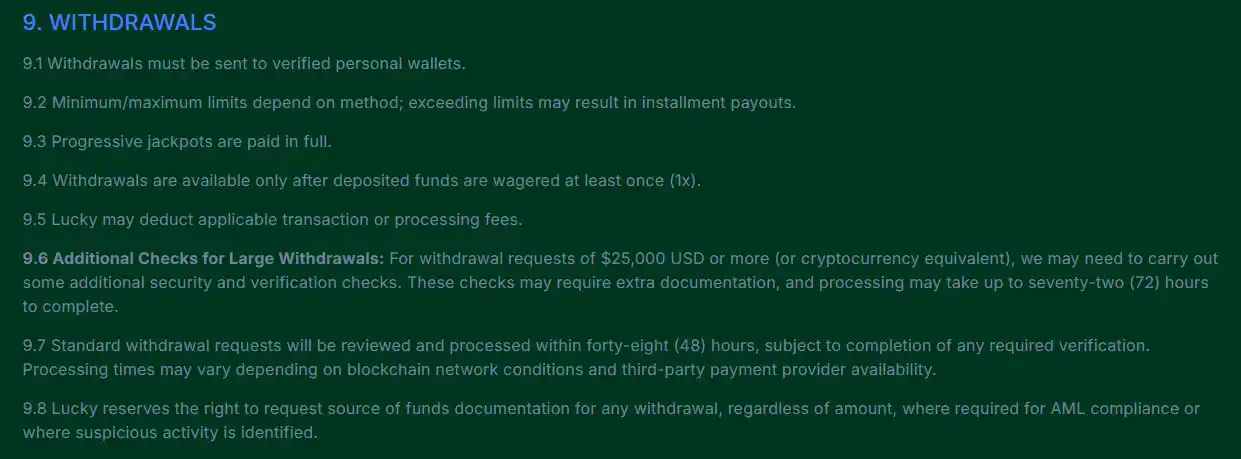
It means a player can use cryptographic round data to check that a revealed result is consistent with a commitment made around the wager, provided the game exposes the necessary verification information.
Does a successful verification mean the game is profitable?
No. Verification addresses result integrity. It does not predict future rounds, remove house edge or reduce normal game variance.
What should I compare in a verification check?
Match the round record with the pre-round commitment, revealed inputs and the output produced by the verifier. Exact field names can vary by implementation.
Are Lucky Originals the same as third-party provider games?
No. Lucky Originals are the in-house range. Lucky.fun also carries a broad catalogue from external studios, including providers such as Pragmatic Play, Play'n GO, NetEnt, Evolution, Ezugi and Evoplay.